Every worktree, in one place
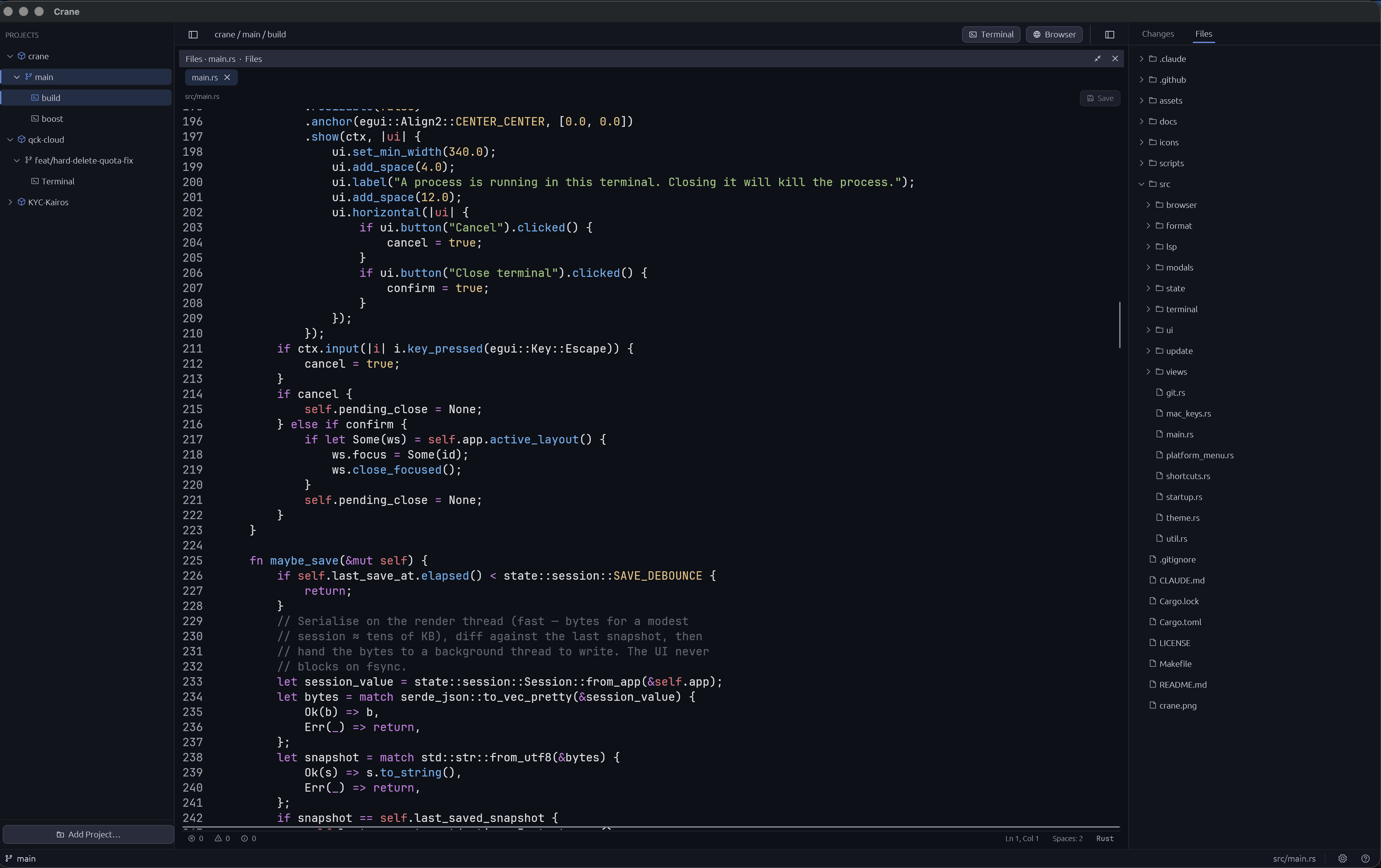
Open a git project and Crane surfaces all of its existing worktrees at once — no checkout dance. Create or delete worktrees right from the app whenever you need a new branch on disk.
Crane is a desktop development environment built entirely in Rust. Terminals, file editing, diffs, and full git workflows — orchestrated across isolated git worktrees, drawn on the GPU, shipped as a single binary.
The model
A clean containment hierarchy — and a single window holds many projects at once. Each Workspace is one of a project's existing git worktrees, so moving between them never disturbs your other work.
Crane was designed from the worktree up. Everything — panes, git, the job system — exists to let you hold several lines of work in your hands at once.
Open a git project and Crane surfaces all of its existing worktrees at once — no checkout dance. Create or delete worktrees right from the app whenever you need a new branch on disk.
Keep several projects open side by side in a single window. Reorder them in the projects tree, and move workspaces between projects that share the same git remote.
Drawn with egui over wgpu. No Electron, no bundled browser, no web runtime. One native binary that starts instantly and stays out of your way.
A DAG history pane (Cmd+9) with lane-based layout and ref pills — green HEAD, purple local, blue remote, yellow tag. Right-click any commit to checkout, branch, spin up a worktree, cherry-pick, revert, or copy its hash.
Staged and unstaged tracking with per-hunk staging in the diff pane, plus a branch picker in the status bar that switches branches across every repo in the active workspace.
No async runtime — just std::thread with parking_lot. A bounded JobSystem with cooperative cancellation. Only real file changes wake background work.
Split, stack, and arrange any of these into a tab. Each pane is native code.
No background spinning, no idle subprocesses, no garbage-collected runtime. Crane leans on threads, bounded work pools, and aggressive caching so the machine stays quiet until you actually do something.
Grab a pre-built binary below, or build from source — you only need a recent Rust toolchain.
# pure Rust, ~99% of the tree
git clone https://github.com/rajpootathar/Crane.git
cd Crane# requires Rust 1.94+
cargo run --releasePoint Crane at a git repo (or any folder) and it surfaces every worktree the project already has. Add or remove worktrees as you need them, open as many projects as you like, then split a tab into the panes you want. Your session saves to ~/.crane/session.json automatically.
Pre-built binaries for every desktop. One file, no installer ceremony.
Apple Silicon & Intel in one image.
Download ↗ LinuxDrop-in package for apt-based distros.
Download ↗ WindowsPortable archive — unzip and run.
Download ↗Prefer to build it yourself? Build from source → · All releases live on GitHub ↗